Words: 1712 | Estimated Reading Time: 9 minutes | Views: 111
Chinese buyers are shifting from buyers to sellers in Tokyo’s housing market. The real variable is not price but permanent residency and outbound-capital rules, with bayside towers taking the first hit.
For the past decade, “Chinese buying Japan real estate in a frenzy” was almost market common sense. It underpinned many brokerage business models and gave local investors a psychological backstop that “someone will always take the other side, no matter how pricey.”
On September 13, 2026, a Rakumachi News dialogue upended that premise: Yudai Masutomo, a journalist on China and Southeast Asia and author of the nonfiction work “Jun-nichi,” sat down with Tomohiro Makino, president of Oraga Souken and author of “The Foreigners’ Real Estate Problem.” Their conclusion—the buying-spree era is over; selling is now accelerating.
For holders weighing exit timing, this is not a sentiment headline but a repricing of where liquidity will come from.
Event recap: a conversation that overturned common wisdom
Masutomo’s first sizing point: post-COVID, Chinese migration to Japan surged; Chinese residents in Japan now number over 900,000, large enough to influence the property market itself. Makino adds an even starker figure: among foreign residents in Japan, one in four is Chinese.
In his home ward, Bunkyo, this ratio is pushed to the extreme—54% of foreign residents are Chinese. With top-rated public elementary schools and a preference among wealthy Chinese to cluster, second-hand condos in good school districts were routinely taken the moment they listed—this was the norm in recent years.
But the dialogue’s focus isn’t on “buy.” Masutomo notes the situation has flipped in recent months: Chinese buyers at China-linked brokerages have dropped sharply, and cross-border real estate investment from China to Japan has “completely stalled.”
Even more notable is the direction of the population itself. The number of Chinese residents in the Tokyo Metropolis fell from January to April this year; it ticked up slightly from April to July, but “a decline” had not happened at all in recent years. This is a signal already visible in residency statistics but not yet reflected in closing prices.
Why bayside towers are the first exit
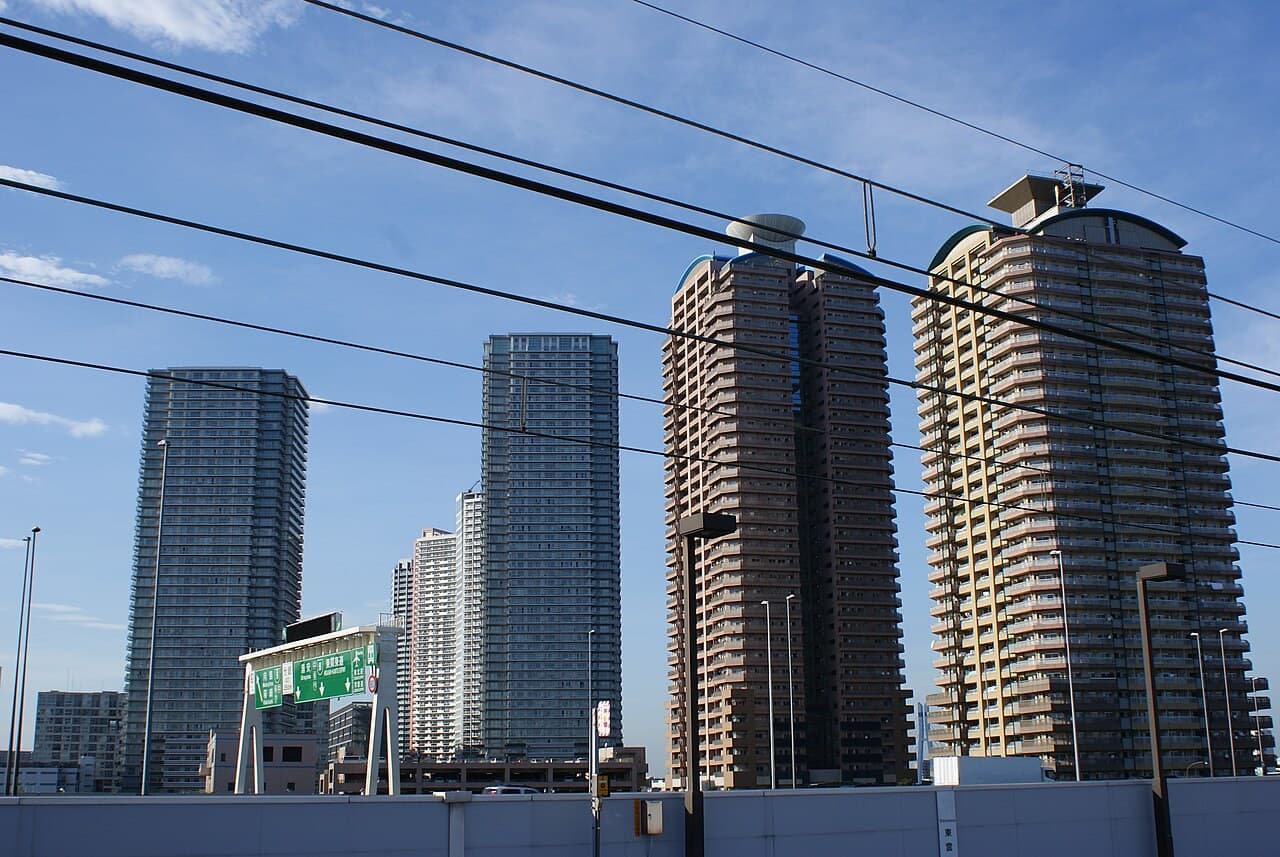
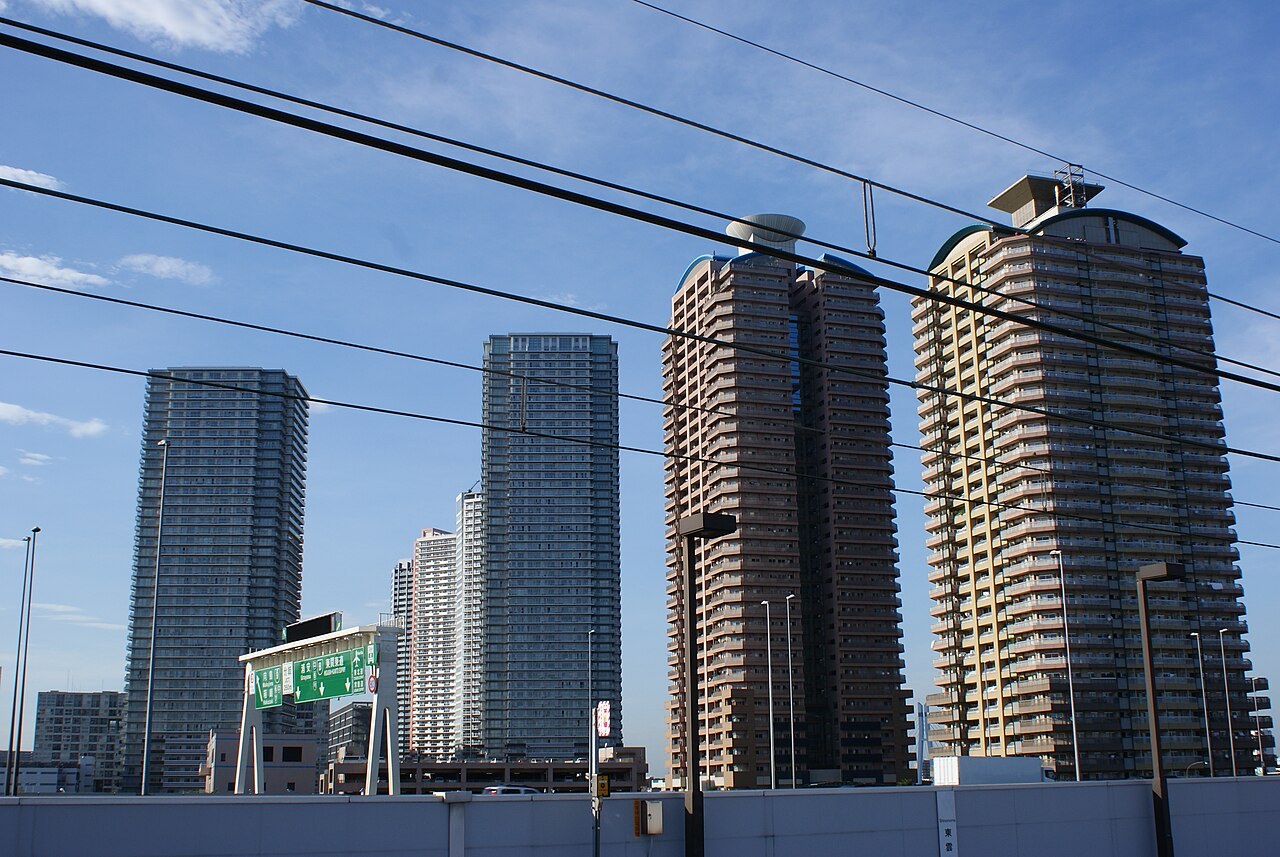
Across Tokyo, the first segment to feel selling pressure is not prime central neighborhoods but bayside towers (high-rise condos). Masutomo observed that dispositions are appearing there first.
The reason isn’t mysterious. Bayside towers have been the most standardized cross-border asset over the past decade: uniform layouts, transparent unit pricing, mature rental markets, and a wide buyer pool on resale. Standardization is an advantage on entry; in a concentrated sell-off it turns into a liability—when multiple units in the same building list at once, price discovery is forced downward.
There’s another peculiarity: community structure. Makino notes the industry has begun using “Chuka-man” (“Chinese bun”) to describe condos where the share of Chinese residents has risen significantly—he stresses it’s not pejorative, just that their presence within the community can no longer be ignored. Masutomo has also heard that in some bayside towers, the heads of the management associations are now Chinese.
When ownership is highly concentrated in a single cohort—and that cohort faces the same policy shifts at the same time—exits naturally synchronize. This is what differentiates the bayside from legacy neighborhoods with dispersed ownership.
Policy chain: how three new rules are tightening in parallel
The real driver of this turn is policy, not prices or rates. Three changes flagged in the dialogue happen to act simultaneously across the full “arrive—remain—fund” chain:
First, Japan’s permanent residency criteria will tighten from October this year. Masutomo explains that permanent residency is one of the so-called “three sacred treasures” in Chinese communities (the other two are a Toyota Alphard business van and a detached house)—the ultimate goal of moving to Japan; once this path is largely closed, selling the home and returning to China or relocating to a third country becomes the logical choice. The Netherlands, Spain, Thailand, and Malaysia are on the relocation list.
Second, China’s new exit–entry regulation taking effect in mid-September allows authorities to discourage or request self-restraint for travel to “high-risk countries.” As China–Japan relations cool, Japan will likely be categorized as such, and new inflows of migrants to Japan will all but stop.
Third, outbound-investment rules effective July 1 direct capital toward Belt and Road member states while visibly tightening for destinations like Japan viewed as “quasi-adversarial.” Masutomo notes that an ultra-high-net-worth friend living in a Minato Ward tower messaged him in late June, “I’m leaving Japan this weekend”—concerned that, under the new rules, information on investments in Japan would flow to the Chinese government.
An even more hidden conduit is closing as well. The informal remittance channels (“underground banks”) used to move funds from China to Japan and convert them into purchase money have seen police action and arrests on the Japan side, while in China they’re being continually suppressed as AI-based flow monitoring improves. When the payment rail itself is cut, incremental buyers don’t just slow—they disappear.
Data view: rents and whole-building prices have already moved first
Policy signals often lead transaction data, but bayside pricing has in fact already stirred.
Pulling rental-apartment statistics for the Toyosu station area on the Urbalytics platform, the average rent across 362 samples is JPY 239,000 with an average floor area of 53.2 m²; converting rent to price per tsubo shows a trend from JPY 15,800 in Q3 2025 to JPY 14,900 in Q3 2026, a 5.7% cumulative decline over five quarters. The drop is modest, but the direction is clear—rents are not providing fresh support for prices.
Moves are steeper on the whole-building (一棟) side. In the neighboring Tsukishima station area, the average asking price per tsubo for buildings listed for sale fell from JPY 5,539,500 in Q4 2025 to JPY 4,362,000 in Q3 2026, a 21.3% retreat over four quarters; over the same period, the average gross yield (表面利回り) is 3.42%, with a median of 3.72%. Note that sample size over the last two quarters is only five, so treat this as indicative rather than conclusive.
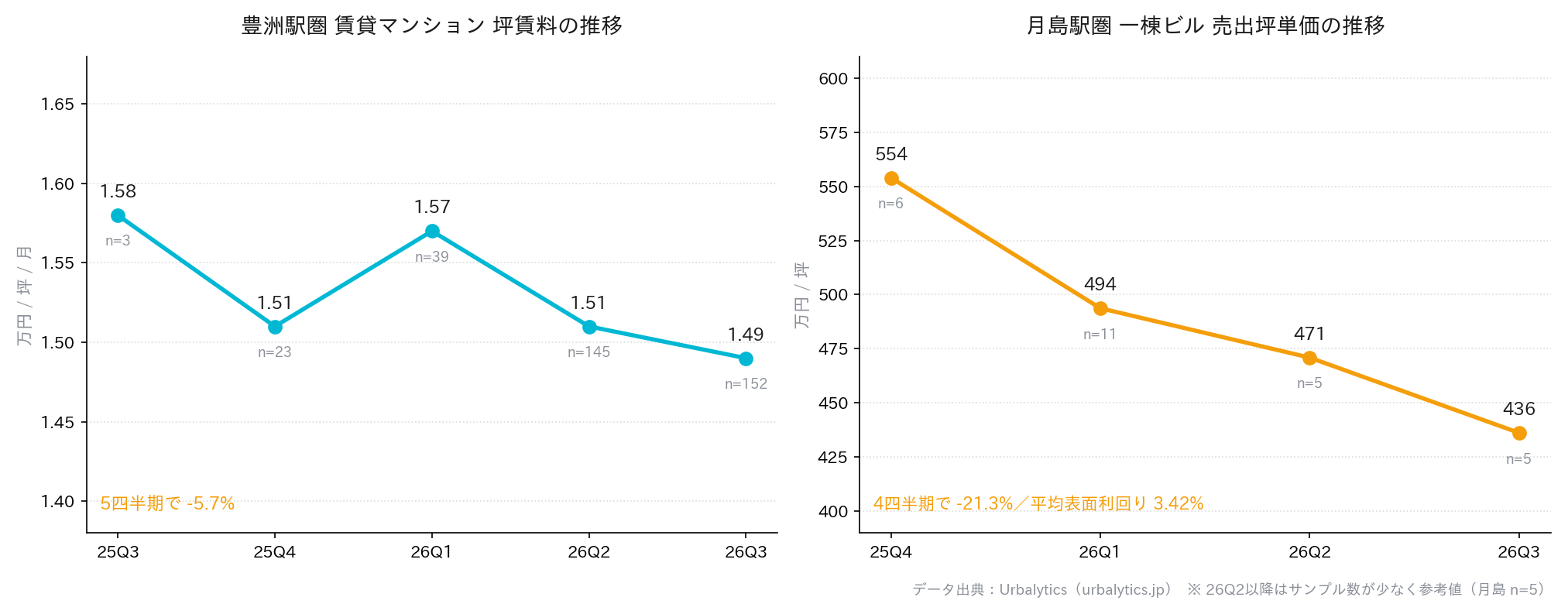
Urbalytics Insights Urbalytics’ internal data can surface such inflection points early because it captures samples on both the active-listing and closed-deal sides, not just lagged post-closing statistics. A steady decline in listing price per tsubo usually means sellers are proactively cutting to compete for a limited buyer pool—this tends to show up two to three quarters ahead of changes in average closing prices. Investors can use the platform’s area comparisons and yield-distribution tools to filter these “listing-leads” signals by submarket.
Investor playbook: who’s exiting, who’s entering
Treating Chinese buyers as a single bloc leads to the wrong conclusion. Masutomo emphasizes the picture is “mottled,” with divergence happening simultaneously.
The most affected are the mass affluent and upper-middle segments: their funding channels, visa paths, and permanent-residency expectations are being compressed at once, rapidly reducing the appeal of holding Japanese assets. The ultra-wealthy are almost unaffected; they can still come to Japan and buy prime Tokyo land to build JPY 2 billion-plus homes—and this is even accelerating.
Chinese brokerages’ client mix is being rewritten. The target is shifting from “China-based Chinese” to Chinese already in Japan, UHNW, and other Chinese-speaking markets such as Taiwan and Singapore. Citing a November 2025 MLIT survey, Makino notes that among overseas-address buyers of new condos in Tokyo, Taiwan ranked first, not China. He also cautions that the survey only counts buyers whose registered address is overseas; purchases via Japan-based paper companies (ペーパーカンパニー; shell companies) are not captured, so only part of the reality is recorded.
Taiwanese capital has its own logic: sharp home-price gains and scarcity of quality assets at home, while Japanese assets look cheap on both currency and quality. Put differently, the bid hasn’t vanished—it has just changed passports.
Risk warning For investors holding bayside towers, the real risk isn’t “the Chinese left,” but that the exit-side buyer pool is structurally narrowing: the price band that used to clear with cross-border middle-class demand (roughly JPY 80–150 million) is simultaneously losing both Chinese middle-class bids and low-rate-driven domestic investment demand. If you plan to exit within the next 12 months, stress test against two indicators—“number of active listings in the same building” and “days on market”—rather than looking only at area averages.
Makino’s macro assessment from the dialogue is worth quoting: rising rates make it harder for domestic Japanese investors to act; areas where rents can rise remain investable, but elsewhere market capital has clearly stalled. And the one remaining hope—“foreigners putting in a floor under a weak yen”—is, at least on the China side, no longer something to count on.
Conclusion: recalculate “who catches the exit”
The significance of this turn is not a single quarter’s price move, but that a premise assumed for ten years is failing. As far as Chinese capital is concerned, the precondition behind “foreign buying sprees support the market” has changed.
For investors considering exits from central-city and bayside condos, listing dynamics after this autumn are the variables to watch:
First, track the number of units listed simultaneously in the same building; this is the most direct leading indicator of concentrated selling and is far more sensitive than area averages.
Second, re-segment your buyer pool by passport. The preferred submarkets, price bands, and layouts of Taiwan and Singapore capital do not fully overlap with those of past Chinese buying; misreads will show up directly in time-to-close.
When these need to be taken down to specific buildings and specific price per tsubo, Urbalytics’ area transaction and rent data can provide direct answers.
#Japan real estate #Tokyo condos #Bay-area towers #Toyosu #Tsukishima #Bunkyo Ward #Chinese investors #Permanent residency #Cross-border investment #Gross yield #Whole-building investment #Tokyo property market #Taiwan capital #Asset exit #Urbalytics
References
- Rakumachi News, “The era of ‘bakugai’ is over: Why wealthy Chinese have started selling Japanese condos,” September 13, 2026, https://www.rakumachi.jp/news/column/406407
- Yudai Masutomo, “Jun-nichi” (nonfiction book)
- Tomohiro Makino, “The Foreigners’ Real Estate Problem,” Oraga Souken
- Ministry of Land, Infrastructure, Transport and Tourism (MLIT), “Survey on purchases of new condominiums in Tokyo by overseas residents,” published November 2025 (cited in the Rakumachi News dialogue)
- Urbalytics platform data (Toyosu station-area rental statistics n=362 / Tsukishima station-area whole-building yield statistics n=18), July 2025–September 2026, https://www.urbalytics.jp
Copyright: This article is original content by the author. Please do not reproduce, copy, or quote without permission. For usage requests, please contact the author or this site.