Words: 1411 | Estimated Reading Time: 8 minutes | Views: 35
Soto no Mori is replacing the South Exit’s largest closed-off parcel with green space, but what truly underpins this area is a 7.78% median whole-building cap rate—not foot traffic.
Around major suburban stations in Japan, large tracts of unused land are rare. Hachioji is an exception—it has roughly 5.2 hectares of blank space right in front of the station, long sealed behind a 4-meter-high concrete wall.
Behind the wall was the Hachioji Medical Prison. After the facility relocated in 2018, the site sat silent for seven years. In October 2026, it will reopen as the mixed-use facility "Soto no Mori."
For investors, the real question isn’t how pretty the park is, but whether a non-commercial-led public regeneration can actually shift the rent and pricing structure of a suburban station area.
I. From "high wall" to "oasis": half a century of the South Exit being locked up
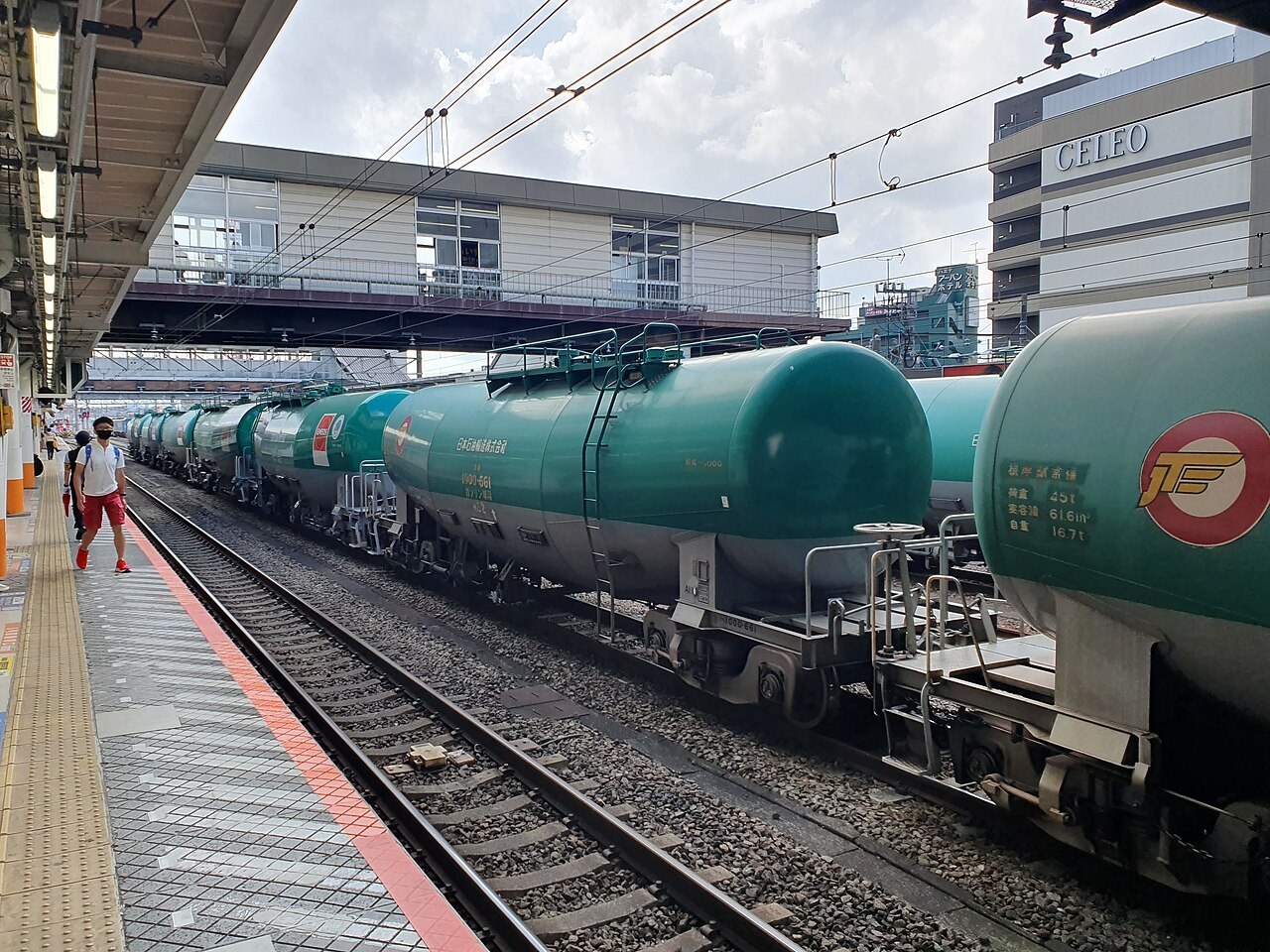
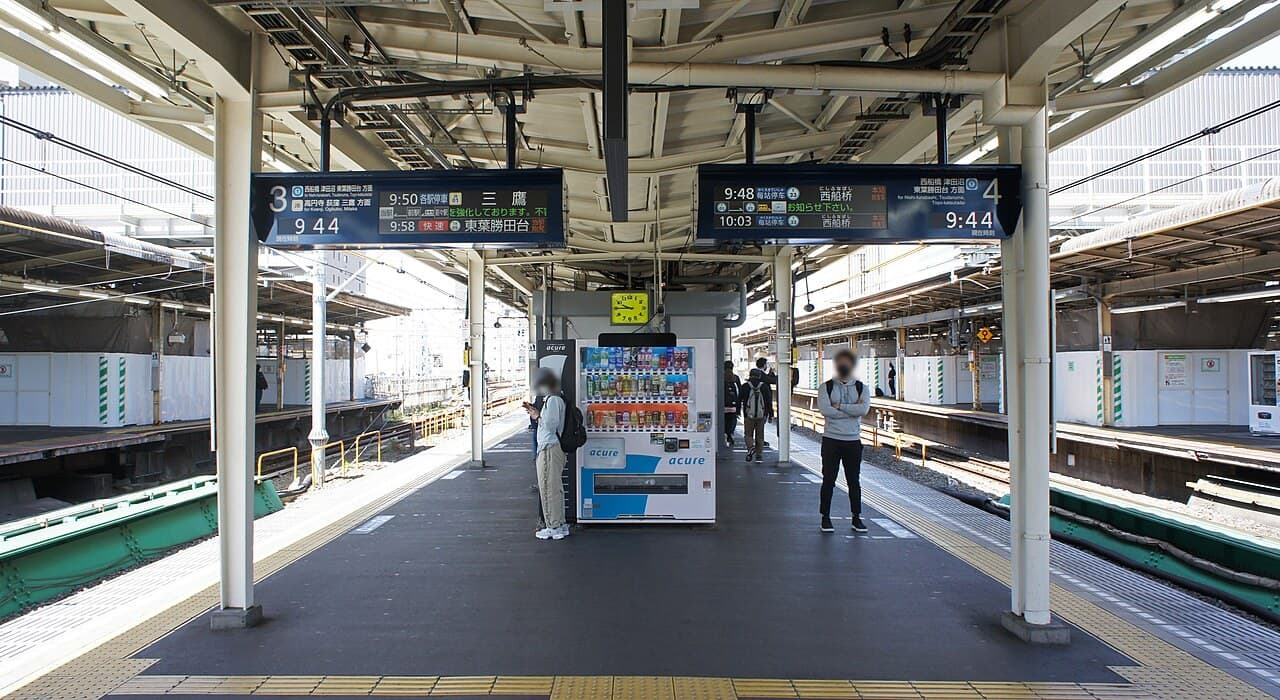
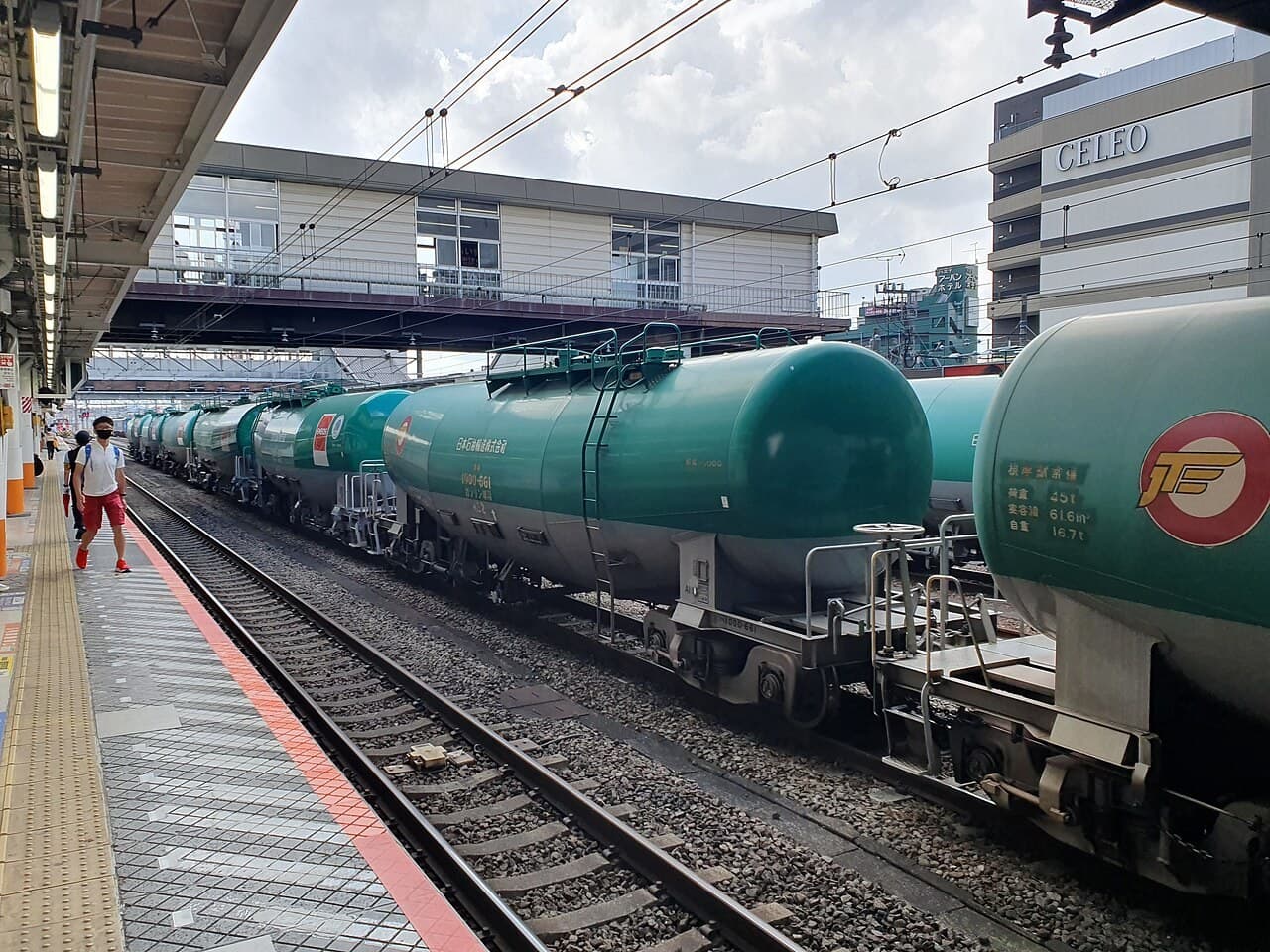
First, the station’s weight. The JR Chuo, Yokohama, and Hachiko Lines intersect here; the station even handles petroleum transport bound for Koshinetsu. Within walking distance is Keio-Hachioji Station—within Tokyo’s Tama area, Hachioji ranks with Tachikawa as a top-tier terminal.
Limited Express, Special Rapid, and Commuter Rapid services on the Chuo Line all stop here, and crucially, there are originating trains. Being able to commute seated is hard currency in suburban rental demand.
Commercial density is also high. The North Exit has large retail complexes and shopping streets; the South Exit concentrates the station building (Celeo) and retail serving tower condominiums. With universities and vocational schools clustered nearby, real demand is deep—from single students to dual-income families.
The problem is precisely the South Exit. For decades, that wall severed circulation and walkability, putting north and south on very different development trajectories. Only after the prison moved out in 2018 could the site be written back into the city plan.
That’s why expectations for Soto no Mori are elevated: it heals not just a parcel, but the South Exit’s long-suppressed neighborhood continuity.
II. By the numbers: rents climbing, prices whipsawing
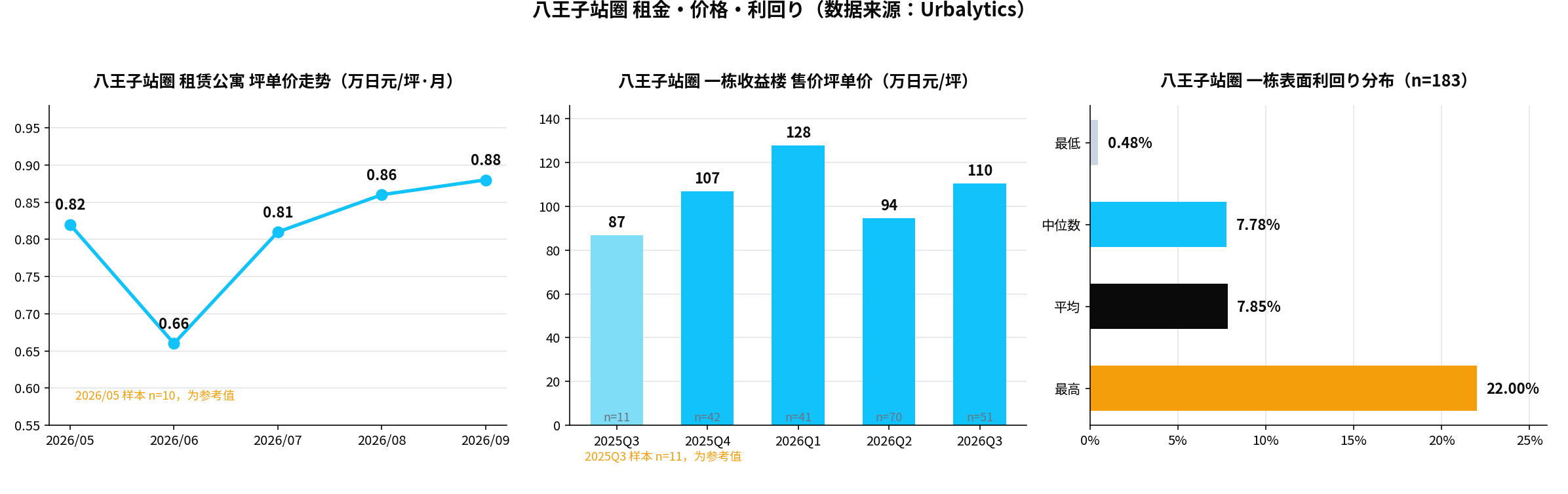
Set sentiment aside and look at the data. Urbalytics shows that rental apartment samples around Hachioji average about ¥74,700 per month with an average size of 31.2 m², equivalent to roughly ¥8,000 per tsubo per month.
Rents are trending up. From May to September 2026, rent per tsubo rose from ¥8,200 to ¥8,800 per month, up a cumulative +7.3%. May had only 10 samples and is reference-only, but from June onward each month had 110+ samples, making the trend credible.
The for-sale side is a different picture. Closing prices per tsubo for whole-building income properties traced a sawtooth over five quarters: ¥869,000 → ¥1,069,000 → ¥1,277,000 → ¥945,000 → ¥1,103,000 per tsubo, a cumulative +27%; but single-quarter swings over 25% signal an unstable pricing consensus.
Yield dispersion makes this even clearer. Across 183 samples, gross yield averages 7.85% with a median of 7.78%, spanning 0.48% to 22%—a nearly 40x spread between assets within the same station area.
Urbalytics Insight Side by side, Hachioji today shows: rents steadily rising, prices volatile at elevated levels, and yields highly dispersed. Alpha doesn’t come from the decision to “buy Hachioji,” but from asset selection—the 7.78% median is just the baseline. The edge depends on where you land in the distribution. Urbalytics’ whole-building yield distribution and rent benchmarking tools are built to locate that dividing line.
III. What is Soto no Mori: 52,000 m², four facilities, a "non-commercial" development
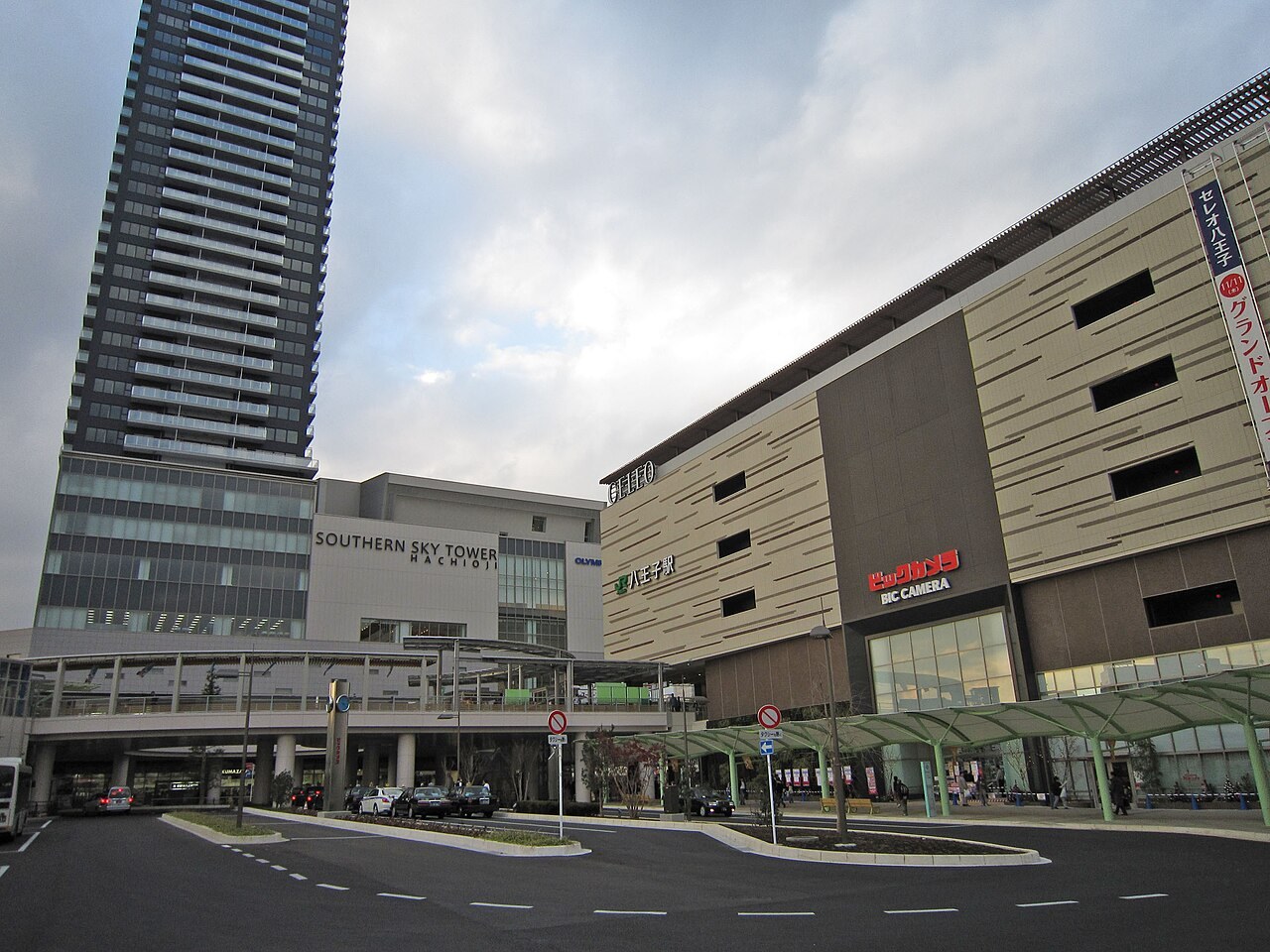
The formal name is the Hachioji Central Park Complex; “Soto no Mori (Sōto no Mori)” is the nickname. The site is about 52,000 m² with only about 8,000 m² of total floor area—note the ratio: an extremely low floor-area ratio, which speaks to the project’s nature.
It comprises four components: Hachioji Central Park (with a lawn plaza and inclusive play equipment), the “Ikoi Library” supplementing Central Library functions, the Hachioji History & Local Museum, and “SPOT HACHIOJI,” an exchange hub with a café and on-site coordinators.
It also serves disaster-prevention roles as a wide-area evacuation site and storage depot. In an era of recurring debate over a Tokyo direct-epicenter quake, having a formally designated evacuation space within ten minutes of the station carries real weight for families choosing locations.
Equally important is what it is not: there will be no large shopping mall, no new tower condos, and no offices. It doesn’t create jobs or office demand; therefore, don’t expect it to lift land values directly the way a commercial-led redevelopment would.
It changes something else—the disappearance of the South Exit’s “backside” feel. Once the prison-site stigma is replaced by greenery, culture, and community functions, the residential case for Koyasumachi and Mancho will strengthen materially.
IV. What this means for investors: four risks—and a more realistic playbook
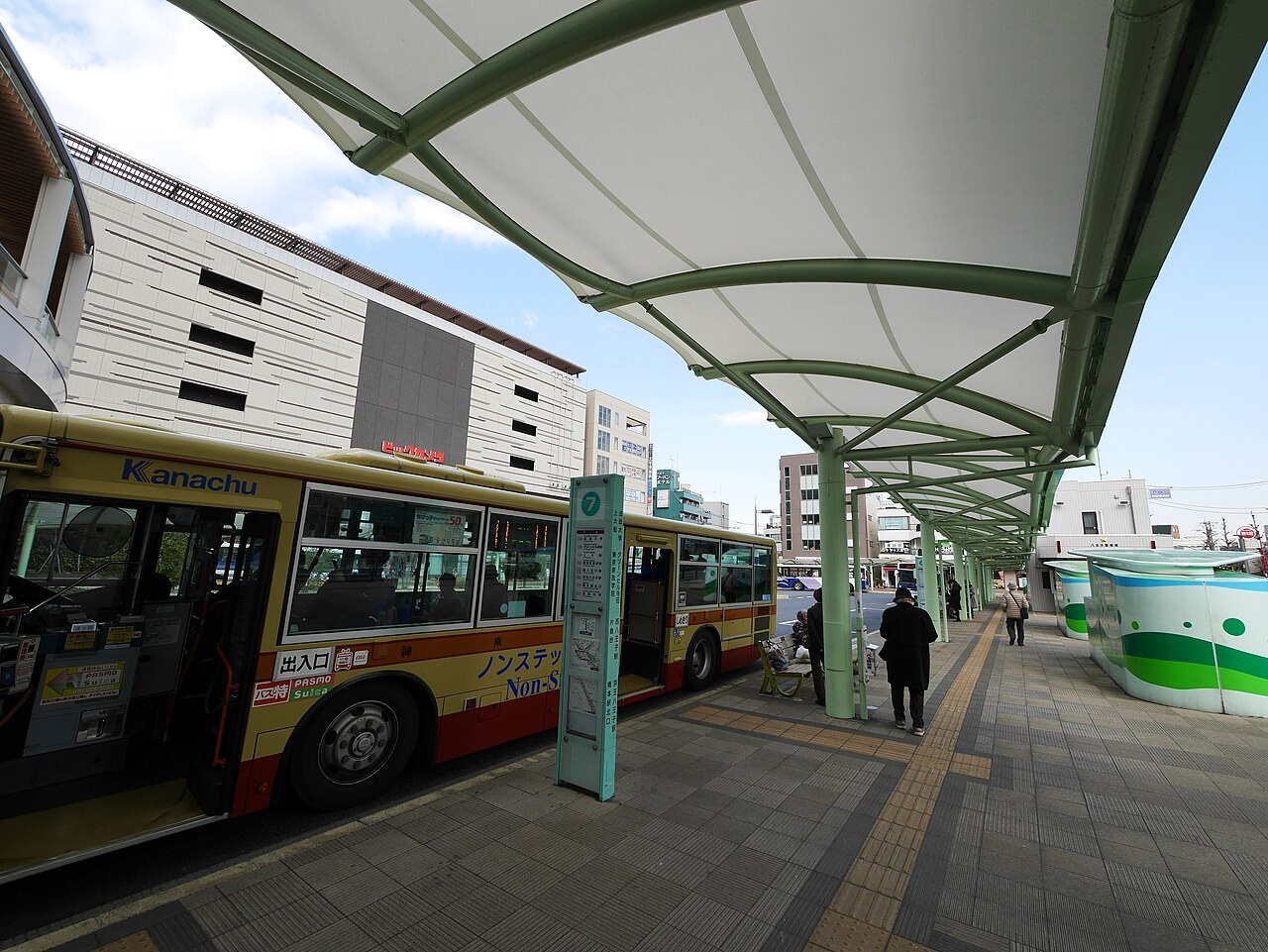
Lay out the risks before the upside. Hachioji’s issue has never been “no residents,” but its awkward position amid the broader re-urbanization wave back to the city core.
On the flip side, there are four risks:
1) Indirect impact on returns. Public facilities improve livability and reduce move-out rates; they don’t spike rents. In your underwriting, Soto no Mori should shift vacancy assumptions, not rent growth.
2) Distance and competition. Hachioji to Shinjuku is about 38 minutes on the Chuo Special Rapid and ~41 minutes on the Keio Limited Express—daytime figures. Versus Tachikawa, Mitaka, and Kichijoji, it remains “one notch farther” in commuters’ minds.
3) Structural erosion of student demand. While Takushoku, Tokyo University of Technology, Soka, Kogakuin, Kyorin, Kyoritsu Women’s, Tokyo University of Pharmacy and Life Sciences, and Teikyo have campuses around Hachioji, Chuo University’s Faculty of Law has moved to Myogadani; Kyorin shifted three faculties to Mitaka Inokashira in 2016; and Kyoritsu Women’s is consolidating undergraduate programs at the Hitotsubashi campus. Anchoring single-tenant studios to one university means your vacancy risk rides on someone else’s enrollment decisions.
4) Elevated pricing compresses margin of safety. Popularity across Tama keeps investment property prices high and gross yields below past levels. With financing costs rising, assets that can’t withstand coarse underwriting will be the first to break.
So what’s the right play? It’s in the rent stack. In this station area, 1R/1K studios typically run from the low ¥30,000s to the low ¥70,000s, with newer, station-proximate stock around ¥50,000–¥80,000. 1LDK–2LDK couple/family units sit around ¥90,000–¥150,000, and larger, newer family units can be set at ¥160,000+.
Studios have a low rent ceiling and are highly exposed to university relocations. By contrast, family layouts and hybrid end-user/investor assets directly capture the park, education, and disaster-prep benefits of Soto no Mori—and that demand doesn’t hinge on any one school’s intake.
Risk warning Chasing Soto no Mori as a “redevelopment theme” by buying at a premium is the easiest mistake this cycle. It’s a park-led public project; its transmission to land prices and rents is a slow variable. What changes cash flow immediately are rising capital costs and studio vacancy risk. Before bidding, run a conservative pro forma using Urbalytics’ rent benchmarks and whole-building yield data, then set your price.
Conclusion: A site’s value depends on what it repairs
Soto no Mori won’t turn Hachioji into Tachikawa overnight, nor will it push rents up a full notch. Its task is simpler: resolve a decades-old South Exit issue and close the last gap in this West Tokyo transport hub’s city brand.
For investors, that’s exactly why it warrants attention. You won’t see flashy spikes, but lower churn and longer tenures from better living conditions are the true sources of stable returns in suburban station areas.
Track neighborhood-building progress and real demand with a cool head, avoid over-expectations, and stay disciplined on location and asset selection—these are the keys to Hachioji. To check rent benchmarks and whole-building yield levels for a specific address, run a comparison directly on Urbalytics.
#TokyoRedevelopment #Hachioji #HachiojiStation #SotonoMori #WestTokyo #SuburbanStationAreas #WholeBuildingInvesting #GrossYield #RentBenchmarks #Koyasumachi #ChuoLine #JapanRealEstateInvestment #VacancyRisk #DisasterPrepHub #Urbalytics
Sources
1. Kenbiya, 2026, "Tokyo, Hachioji Station South Exit: Mixed-use facility 'Soto no Mori' opens on the former medical prison site. A changing transport hub—what are the real estate investment opportunities?", https://www.kenbiya.com/ar/ns/region/tokyo/10551.html
2. Soto no Mori (Hachioji Central Park Complex) official site, 2026, https://sotonomori.jp
3. Hachioji City, 2026, "Hachioji Central Park Complex (nickname: Soto no Mori)", https://www.city.hachioji.tokyo.jp
4. Urbalytics platform data (rent benchmarks and whole-building gross yield statistics, retrieved September 2026), https://www.urbalytics.jp/market
Copyright: This article is original content by the author. Please do not reproduce, copy, or quote without permission. For usage requests, please contact the author or this site.