Words: 1594 | Estimated Reading Time: 8 minutes | Views: 128
The amended Unit Ownership Act shifts the voting denominator from all owners to those present, giving Tokyo’s cohort of sectional‑title condominiums over 40 years old a realistic path to renewal for the first time.
Over the past two decades, the hardest part of dealing with Japan’s aging condos hasn’t been funding repairs—it’s been making decisions. In a 40‑year‑old sectional‑ownership building, several owners are often unreachable, some have passed away, and a notable share are investors who vanish after purchase.
Under the old law, all of them were counted in the denominator for approval rates; absence effectively meant a “no” vote. The buildings most in need of major decisions were precisely those least able to assemble decision‑makers.
The amendment to the Unit Ownership Act effective April 1, 2026 targets this deadlock. For offshore investors holding Tokyo condos, the change isn’t about tax rates—it’s about exit pathways.
I. Why now: the time pressure of 1.48 million units
MLIT’s estimates highlight a number that’s hard to ignore: sectional‑sale condominiums 40+ years old totaled about 1.48 million units by end‑2024, roughly 20% of the national stock of 7.131 million units.
The slope matters even more. The same projection shows this rising to about 2.93 million units in ten years and about 4.83 million in twenty—nearly 3.3 times today. Each decade adds another cohort of aging condos the size of today’s.
The other half of the aging story is human. As residents grow older, attendance at owners’ association (management association) general meetings falls. Health issues, relocation, loss of contact, and unprocessed inheritance all reduce the number of people who can actually express an opinion.
MOJ’s legislative notes call this the “two agings”—rising building age and aging owners. Delay becomes the default, and its erosion of asset value is compounding.
II. What changed: three relaxations, one that matters most
The legal timeline is short. The Amending Act (Act No. 47 of 2025) was enacted on May 23, 2025 and promulgated on May 30, with the Unit Ownership Act and Disaster‑Area Unit Ownership Act parts effective April 1, 2026.
The first relaxation concerns changes to common areas. Previously, the denominator for approval rates was all unit owners; post‑amendment it is attendees at the general meeting. As long as the quorum—more than half by headcount and more than half by voting rights—is met, repair and improvement items can’t be blocked by silent non‑attendees.
This quorum is the critical precondition. If the general meeting can’t muster both majorities, changing the denominator to attendees is moot. In other words, the amendment lowers the bar from mobilizing “everyone” to mobilizing half.
The second relaxation concerns redevelopment resolutions. When a building is certified as lacking seismic resistance, having inadequate fire safety, posing danger to the surroundings, being unsanitary, or noncompliant with accessibility standards, the redevelopment approval threshold drops from four‑fifths to three‑quarters.
The third relaxation addresses “owners who can’t be found.” Unit owners of unknown identity or whereabouts can, once recognized by a court, be excluded from the denominator for approval calculations.
The legislative notes specifically name three categories eligible for exclusion:
First, owners who bought purely for investment, show no interest in management, and neither attend nor respond for extended periods.
Second, former occupants long since moved away, whose registered address no longer matches their actual residence, making notices undeliverable.
Third, deceased owners whose inheritance registration remains unfinished, leaving legal title unconfirmed.
III. In historical context: the fourth structural patch
Viewed on a vertical axis, the weight of this reform is clearer. The core Unit Ownership Act dates to 1962 (Act No. 69 of 1962), when condo sales were just beginning. The law assumed new buildings and did not grapple with end‑of‑life issues sixty years on.
Subsequent revisions largely followed the same path: solve “how to govern” first, then “how to repair.” This time, lawmakers wrote “how to exit” into the core for the first time, connecting redevelopment, bulk sale, and day‑to‑day management within the same statute.
The form of the reform is also notable. It was not a single‑act tweak; it bundled amendments to the Disaster‑Area Unit Ownership Act, the Act on the Promotion of Proper Condominium Management, and the Act on the Facilitation of Condominium Reconstruction, among others.
Such omnibus reform is uncommon in Japan’s real estate law—signaling lawmakers view the problem as too advanced for piecemeal fixes.
Comparatively, Japan isn’t alone in lowering thresholds. Singapore’s en bloc system currently requires 80% owner consent for projects over ten years old and 90% for those ten years or younger; proposed reforms would lower the bar to 70% for 40+ years and 65% for 60+ years.
Both markets point the same way: the older the building, the more society accepts a lower consent bar in exchange for renewal speed. Japan’s 75% threshold in specified cases sits between Singapore’s current and proposed levels, but Japan adds objective certification tests like seismic deficiency, which makes it less flexible in practice.
IV. What it means for investors: a set of real numbers around Tokyo’s Nakano Station
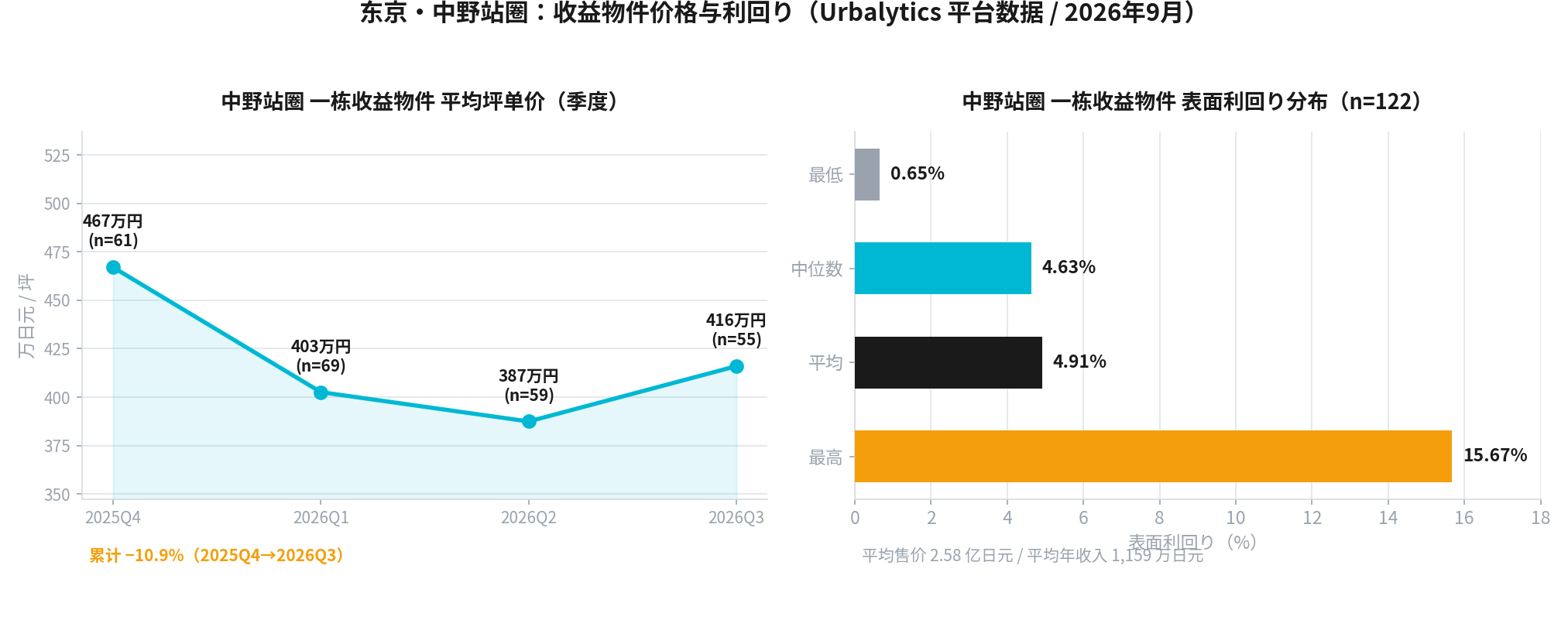
Abstract clauses only matter once they hit pricing. In the Nakano Station area, Urbalytics data show median gross yield around 4.63%, average about 4.91%, across 122 samples, with an average price near JPY 258 million.
The tails tell the story. The top tier reaches 15.67%—mostly 1965–1971 vintage—while the bottom tier is just 0.65%. Within the same station area, building age creates more than a threefold spread in yields.
Concretely, samples include a 1965 building in Kamitakada 2‑chome listed at JPY 29.8 million with a gross yield of about 9.90%; and a 1968 building in Nakano 3‑chome, 345 sqm, listed at JPY 140 million with a yield of about 7.10%.
These high yields essentially price in that the structure is near end‑of‑life and most value resides in the land. Easing redevelopment thresholds changes precisely when and how that land can be re‑deployed.
Pricing is moving too. The area’s average price per tsubo fell from JPY 4.67 million in Q4 2025 to JPY 3.87 million in Q2 2026, then rebounded to JPY 4.16 million in Q3—still down about 10.9% cumulatively.
Urbalytics Insight Overlaying station‑area yield distributions and quarterly price‑per‑tsubo trends by age shows that the shift from four‑fifths to three‑quarters has not repriced all old stock—only cases that both meet seismic‑deficiency certification and carry relatively large land shares. What investors need is to place legal criteria and market data side‑by‑side in the same model.
The implications differ by investor type:
First, for individual investors holding single condo units, the most direct change is a higher risk of being passively pushed out—previously, non‑response could stall redevelopment; now absence forfeits your voice.
Second, for corporates and institutions, the opportunity is on the buy side: 40+‑year assets with questionable seismic performance but solid land shares now allow the redevelopment option to be priced rationally.
Third, for short‑term resale operators, the change is minimal—even with faster decisions, moving from proposal to ground‑breaking still takes years, ill‑suited to 1–2 year capital cycles.
Risk note Lowering the threshold does not make redevelopment easy. The 75% requirement applies only when the building is certified under specified conditions like seismic deficiency; ordinary old buildings still face the four‑fifths rule. After approval, how under‑capitalized owners exit and how compensation is calculated remain practical choke points. Long‑absent foreign owners who fail to respond or attend may lose bargaining position in practice even without a court finding of “unknown whereabouts.”
V. What comes next
It’s reasonable to expect no immediate redevelopment wave in the first two to three years after implementation. MOJ and MLIT ran dense briefings across all 47 prefectures in late 2025, indicating that practical absorption is just starting.
A more realistic path is layered: repair and improvement items accelerate first; next, a set of best‑prepared cases run the full process; eventually, replicable templates emerge. The true inflection likely appears around 2028.
For offshore owners, the task now isn’t guessing policy’s next move but completing your asset’s basic facts: is the registered address deliverable; are your management association contact details current; where do the building’s age and seismic assessment stand.
Two more items merit early action: first, confirm whether a seismic diagnosis has been completed and its result—this directly determines eligibility for the 75% threshold; second, understand the association’s general‑meeting attendance over the past three years and the balance of the long‑term repair fund.
What used to be administrative detail now directly determines whether you still count as a vote. To see where a building sits within its station area—yield percentile, price‑per‑tsubo trend, nearby comps—Urbalytics’ station‑area data lets you run this comparison in a single view.
#UnitOwnershipAct #JapanRealEstate #TokyoCondos #AgingCondoRedevelopment #Reconstruction #CondoManagement #NakanoWard #SingleBuildingIncomeProperty #GrossYield #JapanPropertyInvestment #MinistryOfJustice #MinistryOfLandInfrastructureTransportAndTourism #CrossBorderInvestment #Tokyo23Wards #Urbalytics
References
1. @DIME (Yahoo! News), 2026, “What is the impact on condominium management of the Unit Ownership Act amendment that took effect in April?”, https://news.yahoo.co.jp/articles/ea012e7e1ab0d29a6f45530cd7488b7f0ec550ac
2. Civil Affairs Bureau, Ministry of Justice, 2026, “On the Act to Partially Amend the Act on Building Unit Ownership, etc., to Facilitate the Management and Regeneration of Aging Condominiums, etc.” (Act No. 47 of 2025), https://www.moj.go.jp/MINJI/minji07_00375.html
3. Ministry of Land, Infrastructure, Transport and Tourism, 2026, “Statistics and data on condominiums (number of sectional‑sale condominiums 40+ years old)”, https://www.mlit.go.jp/jutakukentiku/house/jutakukentiku_house_tk5_000058.html
4. The Straits Times / Channel NewsAsia, 2026, “Lower en bloc thresholds to address costs of maintaining old properties”, https://www.straitstimes.com/singapore/politics/lower-en-bloc-thresholds-address-costs-of-maintaining-old-properties-facilitate-renewal-edwin-tong
5. Urbalytics platform data (Nakano Station area single‑building yield and price‑per‑tsubo statistics, retrieved September 2026), https://www.urbalytics.jp/market
Copyright: This article is original content by the author. Please do not reproduce, copy, or quote without permission. For usage requests, please contact the author or this site.